Follow us on Instagram



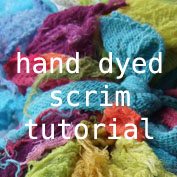


This quick and easy tutorial shows how to hand-dye 2 x 2.5 metre (2 x 2 3/4 yard) pieces of natural cotton scrim (scrim is a 100% cotton, lightweight, very loose weave material, and could also be called cheesecloth).
There are 8 steps.
To achieve 1 deep colour and 1 pale colour
You will need:
5 metres (5 1/2 yards) natural cotton scrim
Procion MX dye (cold reactive dye for fibres such as cotton) colour of your choice
Plastic container large enough to hold 2 litres (3 1/2 pints) of water plus room to stir
Soda crystals (metahydrate sodium carbonate)
Salt
A measuring jug
3 clean jam (jelly) jars
Measuring spoons and plastic spoons
Wooden spoon
Weighing scales
NIOSH-MSHA approved mask for dust (mask is optional - just be very careful not to inhale the dye powder if you don’t wear one)
Rubber gloves (Latex gloves)
It’s a good idea to protect your working surfaces with newspaper or a plastic tablecloth before you start and wear old clothes!
Any spoons or kitchen utensils you use for dyeing should not also be used for food preparation.
1. Soak the scrim in tepid water
This step removes a lot of the yellow colour from the scrim and ensures that the dye penetrates the fabric easily. Agitate the scrim well to get the water into the fibres to help achieve an even colour. After it has soaked for an hour, squeeze the water from the fabric and shake it to loosen it up.
Pushing the scrim into tepid water
2. Make up a dye solution in a clean jam jar
Dissolve approximately half a teaspoon of dye powder in 60ml (2 fl ozs) of tepid water – add a small dash of washing-up liquid to help the mixing process if necessary. The colour will be stronger the more dye powder you add and vice versa.
(Please take great care when handling the dye powder as it is very fine and could easily be inhaled. Always read the safety instructions before you begin. It is also advisable to wear rubber gloves during the dyeing process and to replace the dye pot lid as soon as you have finished with it.
If you are working with children, make up the dye solution beforehand so they are not exposed to the dye powder.)
3. Make up a soda solution in a clean jam jar
Mix 25g (just a little under 1 oz) of soda crystals with 120ml (4 fl ozs) of hot water and stir to dissolve. [1 oz is 28g]
4. Make up a salt solution in a clean jam jar
Mix 30g (just a little over 1 oz) of salt with 120ml (4 fl ozs) of hot water and stir to dissolve.
5. Make up the dye bath
Carefully pour into the container:
All the dye solution
All the soda solution
All the salt solution
2 litres (3 1/2 pints) cold water
6. Carefully put the first piece of fabric into the dye bath
Push it down with a wooden spoon and gently agitate the scrim in the dye bath for 5 minutes, to spread the dye evenly through the scrim. Leave to stand but agitate the fabric occasionally.
7. After 20 minutes, put the second piece of fabric in with the first piece (both pieces remain together in the bucket for the rest of the dyeing process).
Push the scrim down with a wooden spoon and gently agitate it in the dye bath for 5 minutes, to spread the dye evenly through the scrim. Leave to stand for a minimum of an hour, agitating it occasionally. You can leave it for a few hours or overnight if you need to but the dye solution only remains active for about 3-4 hours.
8. Washing and rinsing
Carefully squeeze as much dye as you can from the scrim before removing it from the container.
Rinse the scrim in cold water until the water runs clear.
Wash the scrim in hot soapy water (preferably using eco-friendly laundry liquid, nothing with any bleaches in it).
Rinse the scrim in cold water until the water runs clear.
Hang to dry.
You now have 2 beautiful pieces of hand-dyed scrim to use in your felt-making, machine embroidery, embellishing machine or other art work.
Please let us know if this tutorial was helpful to you, or if you think any of it is unclear so we can update it and make it better. Thank you!
If you liked this tutorial you might like our eBook Creating Felt Artwork that shows you step by step how to make a beautiful meadow picture or create your own picture, where you can use some of your beautiful hand dyed scrim :)